An electrical inspection before power is turned on is written into Ohio's electric service rules. Before an investor-owned electric utility energizes a new service, the utility has to verify that the meter base and the equipment behind it have been inspected. A finished job with no inspection on file stays dark.
Building Compliance Solutions performs these inspections across twelve Central Ohio counties as a State of Ohio certified third-party agency, license #4719. This guide covers what the rule says, who is allowed to inspect, what the inspector looks at, and what to have ready.
What electrical inspection does Ohio require before power is turned on?
Ohio requires an inspection of the meter base and associated equipment before an investor-owned electric utility energizes initial service at a location. The rule is Ohio Administrative Code 4901:1-10-05, paragraph E. The current version of the rule took effect April 8, 2024.
The rule gives two paths:
- Where there is a local inspection authority, the installation has to be both inspected and approved by that authority.
- Where there is no local inspection authority, the installation has to be inspected by a licensed electrician.
The duty to verify sits with the utility, which is why a utility asks for inspection paperwork before it energizes a service.
The rule applies to investor-owned electric utilities. Electric cooperatives and city-owned electric systems are outside that chapter of the code, so a customer of one should ask it what it requires.
Who is allowed to perform an electrical inspection in Ohio?
Inspecting electrical work for compliance with the Ohio Building Code or a local electrical code, for pay, takes a state certificate. Ohio Revised Code 3783.06 says no person shall engage in the practice of electrical inspection in Ohio without a certificate of competency as an electrical safety inspector.
Under Ohio Revised Code 3783.01, the practice of electrical inspection covers a person who, for compensation, inspects the construction and installation of electrical conductors, fittings, devices, and fixtures to determine compliance with the Ohio Building Code or a local electrical code.
The utility rule's second path is separate from that certificate. Where no local inspection authority exists, an inspection by a licensed electrician satisfies the state utility rule.
Does the building department or a private inspector do the inspection?
The building department inspects the work it permits, and the utility company decides what it accepts for work outside a permit. When a permit covers the job, the building department's approval is what the utility needs.
Some electrical work does not need a building department permit. Union County's building department publishes a list of electrical work that does not require its approval or a permit, amended July 11, 2025. The list includes:
- Temporary poles and pedestals
- Free-standing services not associated with a permitted building or structure
- Electrical installations for agricultural buildings
- Site lighting and parking lot lighting not connected to building services
Union County still issues a permit for work on that list when the applicant asks for one.
For work outside a permit, a private inspection supplies a certified third-party inspection and a signed report in the form the utility company asks for.
| The job | Who inspects | What the utility needs |
|---|---|---|
| New building under a permit | The building department that issued the permit | That department's approval |
| Service upgrade or alteration under a permit | The building department that issued the permit | That department's approval |
| Work that needs no building permit, such as temporary power | The inspector the utility company accepts: a licensed electrician under the state rule, or a certified third party | A documented inspection in the form the utility asks for |
Requirements vary by utility company and by the type of service. Ask the utility what it needs while the work is still in progress.
What does the inspector look at?
The inspector checks the service and the equipment it feeds against the edition of the National Electrical Code that applies to the job. For commercial work, the Ohio Building Code that took effect March 1, 2024 references the 2023 edition of NFPA 70, the National Electrical Code.
An electrical inspection from Building Compliance Solutions covers service, feeders, branch circuits, panels, grounding, and equipment. The result of an inspection is a pass or a correction list. Every correction names the specific condition, cites the code section, and says what corrects it.
Does a solar installation need an inspection too?
A solar installation needs approval from electric code officials before its interconnection agreement takes effect. Ohio Administrative Code 4901:1-22-10 says the interconnection agreement is not effective until the system is approved by electric code officials with jurisdiction over the interconnection. The current version of the interconnection rule took effect March 25, 2024.
Building Compliance Solutions inspects rooftop and ground-mount solar: racking, conductors, disconnects, labeling, and rapid shutdown.
What should you have ready before you request an inspection?
Have four things ready before you request an inspection:
- The job site address and the jurisdiction
- Which utility company is waiting, and what it asked for
- The date the work will actually be ready
- A site contact, and any gate codes
If the work does not pass, you get the specifics, so the fix takes one trip. The re-inspection goes on the schedule before the inspector leaves.
Why does scheduling matter more in Central Ohio right now?
The twelve counties Building Compliance Solutions serves authorized more housing in 2025 than in either of the two years before, and every new home and apartment needs an electrical inspection before the power goes on. The twelve counties authorized at least 16,233 housing units by building permit in 2025, according to the U.S. Census Bureau's Building Permits Survey. The 2025 total is up from 14,366 units in 2024 and 11,958 units in 2023, a 36 percent increase from 2023 to 2025. Franklin County accounted for 10,494 of the 2025 units, and 8,168 of those were in buildings with five or more units.
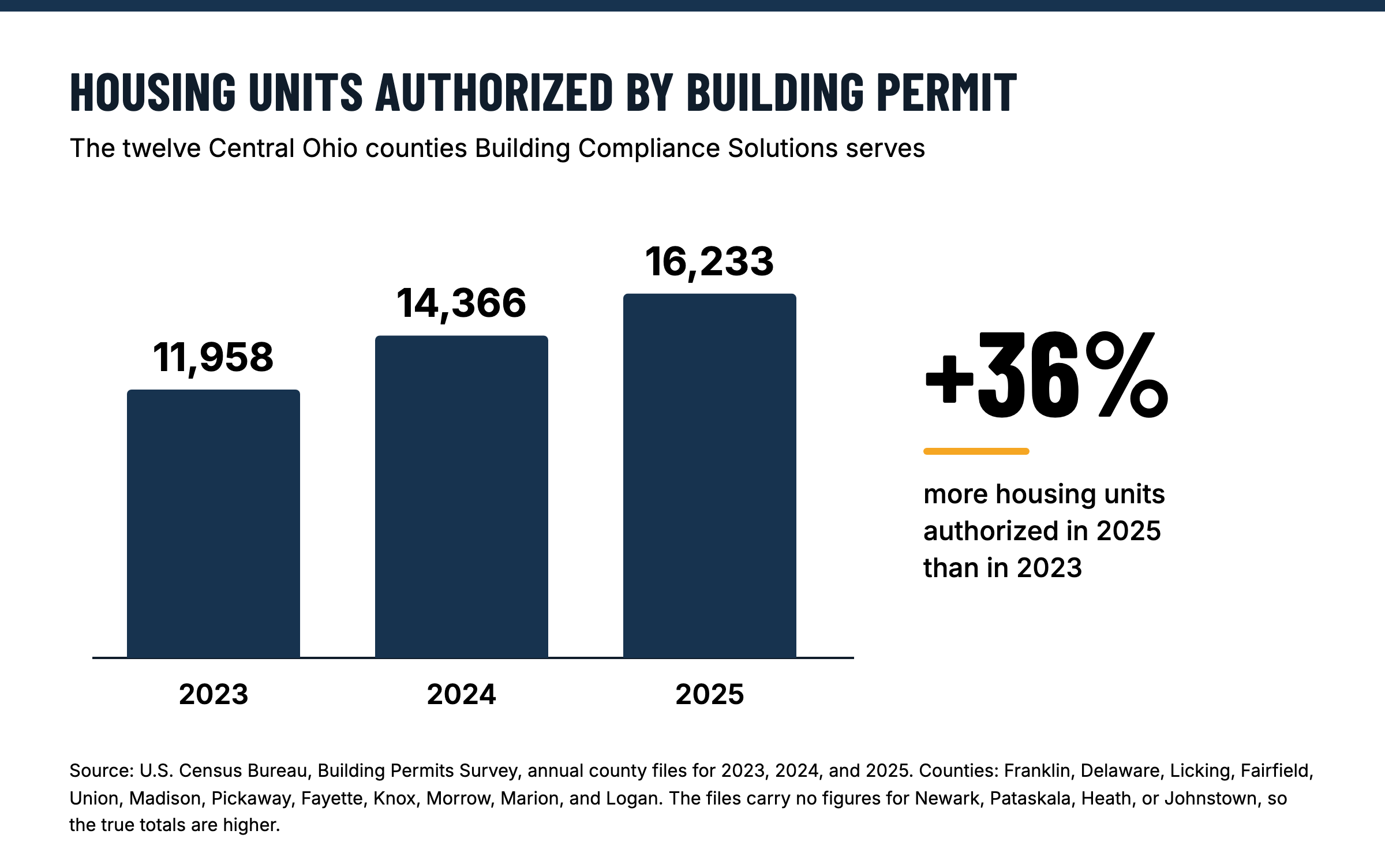
The Census count is a floor. The Census files carry no figures for Newark, Pataskala, Heath, or Johnstown in Licking County, so the real totals are higher.
More construction means more inspections to schedule. Request the inspection when you know the ready date, not on the day the crew leaves.
Where does Building Compliance Solutions inspect?
Building Compliance Solutions inspects in Franklin, Delaware, Licking, Fairfield, Union, Madison, Pickaway, Fayette, Knox, Morrow, Marion, and Logan counties. Our inspectors hold International Code Council certifications in the disciplines they inspect. Send the job details through the inspection request form and we will come back with a confirmed window.
Published November 2, 2026. By Building Compliance Solutions, LLC.